Father Cimatti's educational background |
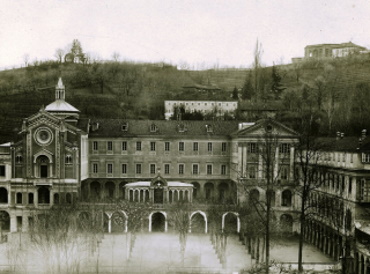
Versalice around 1900 |
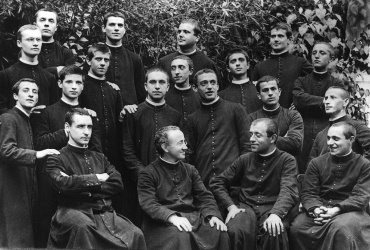
To Father Piccetta, Rector, circa 1906
|
To be a school teacher, you need a qualification.
Father Cimatti entered the Salesian Order in 1896 at the age of 17.
Founded in northern Italy in 1859 by St. John Bosco, the Salesian Order is a Catholic religious order with the mission of education.
Today, the Salesians are dedicated to educating poor and disadvantaged young people in 130 countries around the world,
and, based on Christian love, aim to develop them into capable citizens who can contribute to society. University of Turin, Department of Natural Sciences and Agriculture
In October 1889, the young Cimatti enrolled in the Faculty of Natural Sciences and Agriculture at the University of Turin, earning his doctorate in July 1903.
Between 1905 and 1922, Dr. Cimatti published 453 articles in Italian agricultural journals, covering a wide range of subjects.
The articles on beekeeping alone would make excellent instruction manuals. Royal University of Music of Parma
Furthermore, in July 1900, he took the exam at the Royal Conservatory of Music in Parma. Although the evaluation of external candidates was strict,
he achieved excellent results and received the "Maestro's Diploma." This was the result of his natural talent and hard work.
"Ave Maria," which is still often sung today, was composed around this time.
Faculty of Philosophy, University of Turin
In 1903, he transferred to the Faculty of Philosophy at the University of Turin to obtain a qualification in pedagogy.
At that time, the philosophy taught at national universities was unfamiliar to those studying theology and hoping to become priests.
During his graduation thesis defense, a professor who was a staunch Hegelianist evaluated Fr. Cimatti's ideas as "a supporter of agnostic skepticism."
Although Father Cimatti laughed about this assessment, the experience actually made him wary of philosophy and he always resisted pedantic philosophical arguments.
Later, his studies served him well in teaching pedagogy rather than philosophy. maestro
Father Cimatti was required by his superiors to obtain many teaching qualifications, and although there were many teachers at the Turin Valsalice School,
Father Cimatti alone was considered a "maestro" - a "true teacher" - by the students there,
and he was the only one who continued to be called "maestro" even after he graduated. Cimatti Museum Go to the index page of Father Cimatti's life |